

Why Platinum Terpyridine Complexes Are Interesting Hydrogen-Evolution Cocatalysts
白金ターピリジン錯体は、なぜ水素生成助触媒として面白いのか

1. Connecting light absorption and proton reduction in one molecular platform
At first glance, light-driven hydrogen evolution from water looks like a simple reaction: 2H+ + 2e- → H2. In practice, however, it is a demanding sequence of competing events: light absorption, charge separation, electron accumulation, proton transfer, H-H bond formation, and catalyst regeneration. Classical molecular systems often separate these roles into different components: a photosensitizer such as Ru(bpy)32+, an electron relay such as methyl viologen, a sacrificial electron donor such as EDTA or TEOA, and a hydrogen-evolution catalyst such as colloidal platinum. Such multicomponent systems can work, but they also make it difficult to identify the rate-limiting step, the true active species, and the molecular design rules that should be improved.
Platinum terpyridine complexes, especially chloro(terpyridine)platinum(II), [PtCl(tpy)]+, occupy a particularly interesting position in this problem. Platinum is effective for proton reduction, while the terpyridine ligand contributes visible-light absorption, stabilization of reduced states, and π-acceptor character. The square-planar Pt(II)-tpy framework also tends to associate, and dimers or aggregates with Pt...Pt interactions can generate long-lived 3MMLCT excited states. As a result, this system is not simply “a catalyst containing platinum”; it is a molecular framework in which light absorption and hydrogen-evolution chemistry can be coupled within the same structural motif.
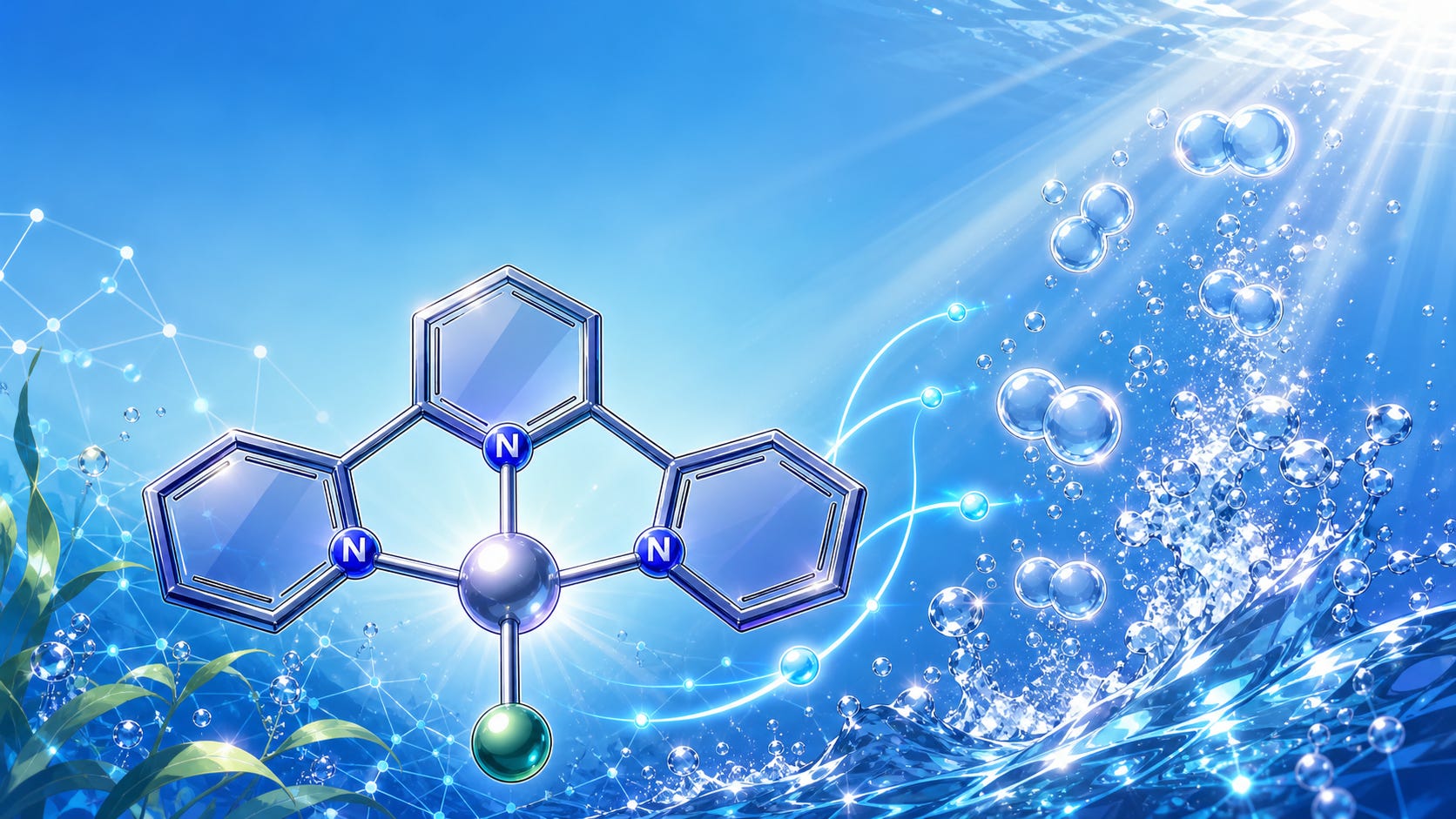
The series of studies from Ken Sakai’s group at Kyushu University explores this feature step by step. The work begins from Pt(II) complexes used as hydrogen-evolution catalysts in Ru(bpy)32+/MV2+ systems, then shows that [PtCl(tpy)]+ itself can serve as both photosensitizer and hydrogen-evolution catalyst. It further demonstrates that viologen-like acceptors and carboxylate groups can be introduced to design electron storage, PCET behavior, and pH response. At the same time, work by Eisenberg and co-workers raised a severe but essential question: is the Pt-tpy species truly a molecular catalyst, or is it merely a precursor to colloidal platinum? The interest of this field therefore lies not only in the observation of H2 formation, but also in the boundary between molecular and nanoparticle catalysis, the coupling of photochemistry with multielectron catalysis, and the way weak association with electron donors can control the reaction.
2. The Sakai-group trajectory: from [PtCl(tpy)]+ to PHEMDs
A central concept in the work of Sakai, Masaoka, Kobayashi, Yamauchi, and co-workers is to treat [PtCl(tpy)]+-type complexes as photo-hydrogen-evolving molecular devices, or PHEMDs. A PHEMD is a system in which light absorption, electron acceptance, and hydrogen evolution are functionally connected within one molecule or within a tightly associated molecular architecture.
The 2009 paper by Okazaki, Masaoka, and Sakai is a key starting point. It showed that [PtCl(tpy)]Cl2 ·H2O evolves hydrogen under visible-light irradiation in the presence of EDTA, even without added Ru(bpy)32+ or MV2+. The authors described the complex as a single-component bifunctional molecular photocatalyst. The activity itself was modest, with a TON of about 3 after 7 h and a quantum yield of about 2%, but the important point was that photosensitization and hydrogen evolution occurred on the same Pt-tpy framework. The rate of hydrogen formation showed a quadratic dependence on complex concentration, suggesting that a dimeric or bimolecular process participates in H2 formation. Saturation behavior with respect to EDTA concentration was also observed, and the authors proposed that ion-pair formation between an associated [PtCl(tpy)]+ species and EDTA facilitates the initial electron-transfer step.
In a related 2012 Dalton Transactions paper, Kobayashi, Masaoka, and Sakai reported [PtCl(Mepytpy)]2+, abbreviated PV2+, in which a methylpyridinium group was introduced at the 4’ position. This molecule was designed as a Pt(II)-based metalloviologen: it retains the platinum terpyridine framework while exhibiting reduction potentials close to those of methyl viologen. PV2+ also acted as a single-component photocatalyst for hydrogen evolution in the presence of EDTA, giving a TON of 4.1 after 12 h. Compared with the parent [PtCl(tpy)]+ system, whose TON was 0.4 under the same conditions, the main improvement was not a dramatic acceleration but greater durability. The authors attributed this behavior to improved stability of the Pt-Cl bond during photolysis.
In the same year, the Angewandte Chemie paper showed a molecule-based Z-scheme-like process in which the one-electron-reduced species, the PV+ radical, is not simply a dark reductant, but must itself be photoexcited to drive the next step. In the PV2+ + EDTA system, the PV+ radical first accumulates. It does not produce H2 efficiently through a dark reaction; instead, the photoexcited state of the reduced species drives the subsequent process. When Pt(II) cocatalysts such as cis-[PtCl2(NH3)2] were added, both the rate and the TON improved, from TON 4.1 for PV2+ alone to TON 18.1 after 24 h for the two-component PV2+ + Pt(II) cocatalyst system. The important conclusion is that hydrogen evolution does not proceed simply because reduced PV transfers electrons to a Pt catalyst in the dark. A two-step photoexcitation process involving re-excitation of the reduced species is required.
The 2015 Dalton Transactions paper by Yamauchi and Sakai examined a tricarboxylated derivative, [PtCl(tctpy)]2-. This complex is anionic, yet it still forms a weak association with EDTA and undergoes reductive quenching by EDTA to drive hydrogen evolution. The especially interesting point is that the basicity of the ligand changes substantially upon reduction, allowing pH-dependent proton-coupled electron transfer, or PCET, to control the driving force of the reaction. The maximum activity appeared near pH 6.2, with a TON of 4.6 after 12 h. The activity remains modest, but the work is important because it shows that carboxylate groups on the Pt-tpy framework can be used to design proton location, electron location, and weak interaction with EDTA through hydrogen bonding or ion-pair formation.
The 2016 paper by Lin, Kitamoto, Ozawa, and Sakai introduced a single pendant viologen acceptor onto the Pt-tpy framework, giving PtL2+-Cn-MV2+ derivatives. These systems improved the TON to 21.5-25.2, clearly higher than the TON of 4.1 for the parent PV2+ system. Under irradiation, the major product is initially a two-electron-reduced state, formulated as a PtL+ radical-Cn-MV+ radical species. This two-electron-reduced species does not thermally evolve hydrogen in the dark. Instead, it must be further photoexcited and reductively quenched by EDTA to reach a three-electron-reduced state that can drive H2 formation. In this sense, the pendant viologen is not merely an electron relay; it functions as a charge-storage site that temporarily holds multiple reducing equivalents during the photochemical cycle.
3. Other Pt-tpy systems: photosensitizers, catalysts, and the colloid problem
The Pt(II) terpyridyl acetylide studies by Eisenberg and co-workers reveal another face of the Pt-tpy motif. In their 2006 JACS paper, a Pt(II) terpyridyl acetylide complex was used as the photosensitizer, MV2+ as the electron relay, TEOA as the sacrificial electron donor, and colloidal Pt as the hydrogen-evolution catalyst. In this case, the Pt-tpy complex mainly functioned in light absorption and charge separation, while H2 formation occurred at the colloidal Pt surface. This is therefore better viewed as a case in which a platinum terpyridyl chromophore drives colloidal Pt, rather than as a case in which the Pt-tpy molecule itself is the hydrogen-evolution cocatalyst.
The 2008 JACS paper has a warning role in the field. It examined systems in which Pt(bpy)Cl2 or [Pt(ttpy)Cl]+ appeared to function as molecular H2-evolution catalysts, and it showed that photodecomposition can generate colloidal Pt, which may become the real hydrogen-evolution catalyst. Mercury tests, TEM, EDAX, and observations on TiO2 supported the conclusion that, under at least some conditions, the active species is not a molecular Pt complex but colloidal Pt generated by photodecomposition. This paper makes clear that observing H2 formation is not sufficient to establish molecular catalysis in Pt-complex systems.
By contrast, the 2013 ChemPhysChem paper by Martis, Mori, Yamashita, and co-workers followed the Pt state in [Pt(tpy)Cl]Cl systems by in situ XAFS. In both the single-component system and the three-component system containing Ru/MV, the local Pt(II) structure was maintained and no clear evidence for Pt(0) colloid formation was observed. This result provides more direct structural support for the molecular-catalyst interpretation proposed from mercury tests and ESI-MS in the Okazaki paper. However, the conclusion should not be generalized to every Pt-tpy system. The boundary between molecular catalysis and Pt nanoparticle precursor behavior depends on ligand structure, light intensity, electron donor, solvent, and surface immobilization.
In another 2008 JACS paper, Du, Knowles, and Eisenberg reported a homogeneous system using a Pt(II) terpyridyl acetylide chromophore and a molecular cobalt catalyst based on a Co(dmgH)2 motif. In this system, the Pt-tpy species is not the hydrogen-evolution catalyst; it is the photosensitizer, while the Co complex performs H2 evolution. More than 400 turnovers were obtained based on the Pt chromophore, and more than 1000 turnovers based on the Co catalyst. This result shows that the strong visible-light absorption and long-lived excited states of Pt-tpy chromophores can be useful for driving other molecular catalysts.
The 2009 Inorganic Chemistry paper immobilized Pt terpyridyl acetylide complexes on TiO2 and used them to sensitize platinized TiO2 for visible-light hydrogen generation. The anchored complexes did sensitize H2 formation, but gave fewer turnovers than the unbound chromophore. Surface orientation, back electron transfer, and oxidative decomposition were identified as problems. Here again, the Pt-tpy molecule functions mainly as a photosensitizer for a semiconductor/metal catalyst system rather than as the hydrogen-evolution catalyst itself.
The 2019 Chemistry - An Asian Journal paper by Su and co-workers reported a heterobimetallic Au(III)-Pt(II) complex in which an Au(III) light-absorbing unit and a Pt(II)-terpyridine catalytic unit were connected by an alkynyl bridge. The design aimed to use the Au unit for light absorption and the Pt-terpy site as the catalytic center. A maximum TON of 91 was obtained in an acetone/water mixture with ascorbic acid as the sacrificial donor. This is a later example of combining a Pt-terpyridine catalytic unit with a strong visible-light absorber. However, the authors also noted that unambiguous evidence excluding catalytically active colloidal or low-coordinate Pt(0) species was still incomplete, leaving mechanism as an open issue.
4. What makes platinum terpyridine complexes interesting
The first point of interest is that the Pt center and the tpy ligand together form both a catalytic center and a light/electron-accepting unit. The π* orbitals of tpy can accept reducing electrons, while the Pt(II) center participates in proton reduction. In typical three-component systems, photosensitizer, electron relay, and catalyst must encounter one another by diffusion. In Pt-tpy systems, part of this sequence can be built into the same molecule or the same associated molecular assembly.
The second point is that Pt...Pt interactions and molecular association are not just side effects; they can create reactivity. [PtCl(tpy)]+ is planar and readily forms dimers or aggregates in a concentration-dependent manner. The dimer-derived 3MMLCT excited state is long-lived enough to receive electrons from EDTA. The quadratic concentration dependence reported by Okazaki and the Pt(II) structural retention observed by Martis through XAFS both suggest that the associated state of Pt-tpy is part of the photocatalytic function.
The third point is the design flexibility for electron accumulation. In PV2+ and pendant-MV systems, viologen-like units accept electrons and enable sequential formation of one-electron-, two-electron-, and even three-electron-reduced states. Hydrogen evolution is a two-electron reaction, which makes it intrinsically difficult to drive with molecular photochemistry that usually moves one electron per photon. Pt-tpy/MV architectures attempt to bridge this gap through molecular design.
The fourth point is that weak association with EDTA is not merely a condition-dependent detail; it becomes a design element. In many Sakai-group papers, saturation behavior with respect to EDTA concentration is observed, and ion-pair formation between an anionic form of EDTA and the Pt-tpy complex is proposed to assist initial reductive quenching. In the 2015 tctpy complex, even an anionic Pt complex and anionic EDTA can associate weakly through hydrogen bonding and related interactions. This gives a useful perspective: the sacrificial donor is not simply an electron source, but also a partner in pre-association and PCET.
This point is especially clear in Fig. 5 of the 2009 [PtCl(tpy)]+ paper. The initial rate of H2 formation increases as the EDTA concentration increases, but saturates above about 15 mM. This behavior is consistent with the idea that the dianionic form of EDTA, H2Y2-, which is the major form near pH 5, forms an ion-pair adduct with the cationic [PtCl(tpy)]+ aggregate, especially (1)22+. This pre-associated state makes electron injection more likely before the short-lived excited state decays. At low EDTA concentration, the Pt complex does not encounter EDTA efficiently; increasing EDTA raises the probability of forming the pre-associated complex and increases the initial rate. Once the relevant Pt aggregates or excited states are essentially captured by EDTA, further EDTA addition no longer increases the rate substantially.
Thus, in this system, the reducing power of EDTA is not the only important factor. EDTA is anionic and can gather near the Pt-tpy complex through electrostatic and hydrogen-bonding interactions, accelerating the initial electron-transfer event. In the 2016 pendant-viologen Pt-tpy study, replacing EDTA with the neutral sacrificial donor TEOA greatly decreased the amount of H2 produced, leading the authors to conclude that ion-pair formation between the cationic Pt complex and anionic EDTA is important for initiating the reaction. Neutral amines such as TEA and TEOA can certainly serve as electron donors in other photocatalytic systems, but the clear EDTA-concentration saturation behavior and rapid reductive quenching through pre-association seen in the Sakai Pt-tpy/EDTA systems should be regarded as features that strongly depend on anionic EDTA.
5. What are the challenges?
The largest challenge is that the activity and durability remain low. The early single-component Pt-tpy systems from the Sakai group show only a few turnovers, and even the improved pendant-MV systems reach TON values only in the 20s. These studies are fundamentally important, but a practical hydrogen-evolution catalyst would require much higher TONs, TOFs, and long-term stability. Because platinum is a precious metal, the turnover numbers must be high enough to justify its use.
The second challenge is dependence on sacrificial electron donors. Most systems discussed here use EDTA, TEOA, or ascorbic acid as the electron source. They are therefore not true overall water-splitting systems in which water oxidation and hydrogen evolution are coupled. If ion-pair formation with EDTA is a major reason for activity, removing EDTA may remove a key part of the mechanism. Extending this design principle to systems connected to water oxidation, electrodes, or semiconductors will require redesigning mechanisms that were originally optimized for sacrificial donors.
The third challenge is proving molecular catalysis. Pt complexes can form Pt(0) particles under photochemical and reducing conditions. Mercury tests are useful but not definitive, because Hg can also affect molecular species or photosensitizers, and not all nanoparticles respond identically to Hg. As shown by Eisenberg and co-workers, observing H2 evolution does not prove that the molecular Pt complex is the active catalyst. In situ XAFS, TEM/EDX, DLS, XPS, UV-vis monitoring during reaction, ESI-MS, poisoning tests, filtration tests, and post-irradiation reactivity tests should be combined to evaluate the true active species.
The fourth challenge is the efficiency of multielectron and multiproton processes. In PV2+ and pendant-MV systems, one-electron- and two-electron-reduced species do not directly evolve H2 in the dark. They require further photoexcitation and reduction to reach highly reduced states. This Z-scheme-like behavior is conceptually elegant, but each step competes with back electron transfer, deactivation, and decomposition. As more electrons accumulate, the molecule becomes more reductively stressed, and Pt-Cl bonds, alkynyl ligands, and viologen units can become vulnerable.
The fifth challenge is control of the reaction field. Association can be beneficial in Pt-tpy systems, but it can also lead to precipitation, self-quenching, inner-filter effects, or unfavorable orientation on surfaces. Increasing concentration increases dimer or aggregate formation, but does not necessarily improve efficiency. In TiO2-immobilized systems, electron injection can occur, yet back electron transfer and decomposition may increase, making immobilized systems worse than the free chromophore. Effective reaction-field design must therefore control association, distance, orientation, local pH, and proton delivery at the same time.
6. Expectations for future development
The most promising direction is to treat the Pt-tpy framework not only as a stand-alone high-activity catalyst, but as a module that rectifies electrons, protons, and light within and between molecules. If electron-storage units such as viologens, quinones, or NADH models can be positioned near the Pt-tpy unit, and if re-excitation of reduced species can be controlled, multistep photoexcitation could become more efficient. The improvement in TON observed in pendant-MV systems shows that this direction is productive.
A second promising direction is ligand design based on PCET. In the tctpy complex, changes in carboxylate basicity upon reduction controlled pH dependence and driving force. Future designs could introduce carboxylates, phosphonates, proton relays near pyridine rings, or internal bases so that proton movement accompanies electron uptake at the right time and place. This idea could also be relevant beyond hydrogen evolution, for example in CO2 reduction or other small-molecule transformations.
A third direction is immobilization on surfaces, polymers, MOFs, or semiconductors while preserving molecular catalysis. However, the TiO2 studies by Eisenberg and co-workers show that immobilization is not automatically beneficial. One must evaluate electron-injection rates, back electron transfer, orientation, local concentration, and accumulation of decomposition products. Scaffolds that control the association behavior of Pt-tpy complexes, for example by allowing ordered dimerization, would be especially interesting.
A fourth priority is direct mechanistic observation. The in situ XAFS study by Martis and co-workers is important because it shows that Pt(II) species can be retained during reaction. Future work should combine time-resolved XAFS, time-resolved IR or transient absorption spectroscopy, EPR, isotope effects, H/D exchange, and spectroelectrochemistry. The key question is which species directly forms the H-H bond: Pt-H, Pt(III)-H, a dinuclear hydride, a ligand radical, or a three-electron-reduced state.
The appeal of platinum terpyridine complexes is not that they are already perfect high-performance catalysts. Rather, they reveal with unusual clarity the central problems faced by molecular photocatalysts for multielectron reactions: where electrons are stored, where protons are accepted, and at what point molecular character is lost. The next challenge is to move beyond EDTA-supported model reactions toward longer-lived, higher-TON systems that retain molecular identity while being connected to realistic electron-supply systems and, ultimately, to water oxidation.
References
R. Okazaki, S. Masaoka, K. Sakai, “Photo-hydrogen-evolving activity of chloro(terpyridine)platinum(II): a single-component molecular photocatalyst,” Dalton Trans. 2009, 6127-6133. https://doi.org/10.1039/B905610F
M. Kobayashi, S. Masaoka, K. Sakai, “Synthesis, crystal structure, spectroscopic and electrochemical properties, and H2-evolving activity of a new [PtCl(terpyridine)]+ derivative with viologen-like redox properties,” Dalton Trans. 2012, 41, 4903-4911. https://doi.org/10.1039/C2DT12209J
M. Kobayashi, S. Masaoka, K. Sakai, “Photoinduced Hydrogen Evolution from Water by a Simple Platinum(II) Terpyridine Derivative: A Z-Scheme Photosynthesis,” Angew. Chem. Int. Ed. 2012, 51, 7431-7434. https://doi.org/10.1002/anie.201202720
K. Yamauchi, K. Sakai, “A tricarboxylated PtCl(terpyridine) derivative exhibiting pH-dependent photocatalytic activity for H2 evolution from water,” Dalton Trans. 2015, 44, 8685-8696. https://doi.org/10.1039/C5DT00425J
S. Lin, K. Kitamoto, H. Ozawa, K. Sakai, “Improved photocatalytic hydrogen evolution driven by chloro(terpyridine)platinum(II) derivatives tethered to a single pendant viologen acceptor,” Dalton Trans. 2016, 45, 10643-10654. https://doi.org/10.1039/C6DT01456A
P. Du, J. Schneider, P. Jarosz, R. Eisenberg, “Photocatalytic Generation of Hydrogen from Water Using a Platinum(II) Terpyridyl Acetylide Chromophore,” J. Am. Chem. Soc. 2006, 128, 7726-7727. https://doi.org/10.1021/ja0610683
P. Du, J. Schneider, F. Li, W. Zhao, U. Patel, F. N. Castellano, R. Eisenberg, “Bi- and Terpyridyl Platinum(II) Chloro Complexes: Molecular Catalysts for the Photogeneration of Hydrogen from Water or Simply Precursors for Colloidal Platinum?” J. Am. Chem. Soc. 2008, 130, 5056-5058. https://doi.org/10.1021/ja711090w
P. Du, K. Knowles, R. Eisenberg, “A homogeneous system for the photogeneration of hydrogen from water based on a platinum(II) terpyridyl acetylide chromophore and a molecular cobalt catalyst,” J. Am. Chem. Soc. 2008, 130, 12576-12577. https://doi.org/10.1021/ja804650g
P. Jarosz, P. Du, J. Schneider, S.-H. Lee, D. McCamant, R. Eisenberg, “Platinum(II) Terpyridyl Acetylide Complexes on Platinized TiO2: Toward the Photogeneration of H2 in Aqueous Media,” Inorg. Chem. 2009, 48, 9653-9663. https://doi.org/10.1021/ic9001913
M. Martis, K. Mori, K. Kato, G. Sankar, H. Yamashita, “What Are the Active Species in the Photoinduced H2 Production with Terpyridyl Pt(II) Complexes? An Investigation by in Situ XAFS,” ChemPhysChem 2013, 14, 1122-1125. https://doi.org/10.1002/cphc.201201093
Y.-B. Su, Y.-J. Yuan, X.-L. Liu, G.-H. Chen, X. Chen, Z.-T. Yu, Z.-G. Zou, “A Heterobimetallic AuIII-PtII Photocatalyst for Water Reduction to Hydrogen,” Chem. Asian J. 2019, 14, 527-531. https://doi.org/10.1002/asia.201801591
K. Sakai, H. Ozawa, “Homogeneous catalysis of platinum(II) complexes in photochemical hydrogen production from water,” Coord. Chem. Rev. 2007, 251, 2753-2766. https://doi.org/10.1016/j.ccr.2007.08.014
H. Ozawa, M.-A. Haga, K. Sakai, “A Photo-Hydrogen-Evolving Molecular Device Driving Visible-Light-Induced EDTA-Reduction of Water into Molecular Hydrogen,” J. Am. Chem. Soc. 2006, 128, 4926-4927. https://doi.org/10.1021/ja058087h
K. Yamauchi, S. Masaoka, K. Sakai, “Evidence for Pt(II)-Based Molecular Catalysis in the Thermal Reduction of Water into Molecular Hydrogen,” J. Am. Chem. Soc. 2009, 131, 8404-8406. https://doi.org/10.1021/ja902245e
H. Ozawa, M. Kobayashi, B. Balan, S. Masaoka, K. Sakai, “Photo-Hydrogen-Evolving Molecular Catalysts Consisting of Polypyridyl Ruthenium(II) Photosensitizers and Platinum(II) Catalysts: Insights into the Reaction Mechanism,” Chem. Asian J. 2010, 5, 1860-1869. https://doi.org/10.1002/asia.201000083
H. Ozawa, K. Sakai, “Photo-hydrogen-evolving molecular devices driving visible-light-induced water reduction into molecular hydrogen: structure-activity relationship and reaction mechanism,” Chem. Commun. 2011, 47, 2227-2242. https://doi.org/10.1039/C0CC04708B
A. J. Esswein, D. G. Nocera, “Hydrogen Production by Molecular Photocatalysis,” Chem. Rev. 2007, 107, 4022-4047. https://doi.org/10.1021/cr050193e